
A prosthetic arm is a custom-fitted device that replaces part or all of an upper limb lost to injury, illness or a congenital limb difference, helping people grip, hold and handle everyday tasks again. This guide explains what a prosthetic arm is, the main types, who typically needs one and how it is used day to day, so you can have an informed conversation with a certified prosthetist.
What Is a Prosthetic Arm?
A prosthetic arm is an artificial replacement for part or all of an upper limb. Depending on the level of limb loss, it can stand in for fingers, a hand, a wrist, a forearm, an elbow or a shoulder. Ottobock points out that these devices cannot fully replace a natural limb, but the right one can help people regain independence, handle everyday tasks and return to work.
Not every prosthetic arm is a robotic hand. Some are designed mainly for appearance, some for one specific job such as gripping a tool, and some for broad everyday movement. Because no two residual limbs are alike, a prosthetic arm is custom made. A certified prosthetist builds the socket that fits over the residual limb, selects the components and adjusts the fit over time.
A prosthetic arm can also support emotional adjustment. Many people report that a comfortable, well-fitted device helps them rebuild confidence in social and work settings after limb loss.
Types of Prosthetic Arms
Clinicians usually group prosthetic arms into three or four categories: passive (cosmetic), body-powered, myoelectric, and sometimes activity-specific devices. Open Bionics and Ottobock describe the differences this way:
| Type | How it works | Best suited to | Main trade-offs |
|---|---|---|---|
| Passive (cosmetic) | No active movement. Looks like a natural limb and can steady objects. | People who value appearance and light support | Little hand-like function |
| Body-powered | A cable and harness link shoulder, chest or residual-limb movement to a hook or hand. | Simple, sturdy, cost-effective everyday and heavy-duty use | Harness can tire the wearer over long days; fewer grip patterns; takes physical effort |
| Myoelectric (“bionic”) | Sensors in the socket read muscle signals and drive battery-powered motors in the hand. | People who want more grip options and no harness | Needs charging, usually costs more, requires enough usable muscle signal and training |
| Hybrid | Combines body-powered and electric parts, for example a cable-driven elbow with a motorized hand. | Higher-level limb loss | More complex to fit and maintain |
| Activity-specific | Built for one purpose such as sport, cycling or lifting. | A particular hobby or job | Not designed for all-day general use |
Neither category is automatically “better.” Medical policy criteria from Kaiser Permanente describe a body-powered arm with a terminal hook as the standard, most durable option, and reserve myoelectric devices for people who cannot use body-powered arms or who need better grip function. Many people start with a passive or body-powered arm and move to a myoelectric device as rehabilitation progresses.
Who Needs a Prosthetic Arm?
People who need a prosthetic arm are those living with upper-limb loss or absence, whatever the cause. Common causes include:
- Trauma. In a multicenter study of 174 people with upper-limb loss in the United States and Japan, trauma was the most common cause, and below-elbow (transradial) loss was the most common level (PMC).
- Disease or surgery. Infection, vascular disease or cancer can require amputation of part of the arm or hand.
- Congenital limb differences. Some children are born with an arm or hand that did not fully form.
The level of loss shapes the options. A person missing a few fingers has different needs from someone with an above-elbow amputation, who may need a prosthetic elbow as well as a hand.
Who benefits most, and who may not
The same multicenter study found that prosthesis users reported higher quality of life and were more likely to be employed than non-users. That is an association, not proof that a prosthesis causes better outcomes, but it shows why many people pursue one.
A prosthetic arm is not right for everyone. A population-based questionnaire study of 224 adults with major upper-limb amputations found that 4.5% never took up a prosthesis and 13.4% later stopped using theirs, mainly because of comfort, function and control (PubMed). Rates vary between studies; the multicenter study above reported 9% abandonment, and other reports cite ranges up to 49% (Rev Esp Cir Ortop Traumatol, 2015).
The PubMed authors flagged higher risk with higher-level amputations, amputation at an older age and, in their sample, among women, and concluded that matching the device to individual needs and offering individualized training should help. If you are weighing a device, ask a prosthetist to explain realistic expectations before you decide.
How a Prosthetic Arm Is Used
Getting and using a prosthetic arm is a process, not a single appointment. A typical path looks like this:
- Evaluation. A prosthetist, often alongside a surgeon or therapist, reviews your goals, residual limb, strength and, for myoelectric devices, how well your muscles produce usable signals.
- Measuring and socket fitting. The socket is custom made and usually tested before the final version, because comfort and suspension decide whether you will actually wear the arm.
- Component selection. You and your prosthetist choose the terminal device (a hook or hand), wrist, elbow if needed, and control system.
- Training. An occupational therapist or prosthetist teaches control and grip, and a gradual wearing schedule helps the residual limb adapt. Ottobock notes that learning to use an arm can be challenging, which is why training matters.
- Daily use and follow-up. Expect adjustments as your limb changes, plus routine care: cleaning the socket and liner, checking the skin and, for myoelectric arms, charging the battery.
How you control the arm depends on its type. With a body-powered arm you move your shoulder or chest to pull a cable. With a myoelectric arm you tense specific muscles to open and close the hand. A passive arm does not move on its own, but it can hold, steady or push objects while your other hand works.
For care routines on a finger, thumb or partial-hand prosthesis specifically, Finger Prosthetics publishes guidance on use of prosthesis and care of prosthesis. For any arm device, follow the instructions your own clinic gives you.
What’s New in Prosthetic Arm Technology
Better control is the area moving fastest. One approach is targeted muscle reinnervation (TMR), a surgery that reroutes nerves from the amputated limb into nearby muscles, which then act as extra signal sources for a myoelectric arm. A 2024 review in the European Journal of Orthopaedic Surgery & Traumatology describes TMR as an option for major upper-limb amputations above the knuckle level. It notes that small studies report better prosthetic control and satisfaction, and that pain relief is now its main indication.
A 2026 systematic review and meta-analysis in Frontiers in Neurology found improved task performance and lower self-reported disability after TMR-based reconstruction. The authors still call the evidence preliminary, because it rests on only five patient groups of limited quality. In short, TMR is promising but not a guarantee, and it belongs in a conversation with an experienced upper-limb surgical team.
How Much Does a Prosthetic Arm Cost, and Will Insurance Pay?
Prices vary widely by type and components. KFF Health News reported a myoelectric hand priced at just over $46,000 without insurance in one case, while body-powered arms are generally described as the more cost-effective option.
Coverage is uneven. Medicare covers 80% of prosthetic limb costs, and most privately insured people still pay a coinsurance share. Insurers sometimes deny devices as not medically necessary or experimental, or cap payments. About half of U.S. states have prosthetic fairness laws, but they apply only to state-regulated plans, and over half of people with private coverage are in self-insured plans those laws do not reach.
Practical steps:
- Ask your prosthetist for an itemized written estimate.
- Ask for a documented functional evaluation to support medical necessity.
- Appeal denials; many are overturned with proper documentation.
When Finger, Thumb or Partial Hand Loss Needs a Different Solution
Not everyone with upper-limb loss needs a full prosthetic arm. If the wrist and forearm still work and the loss is limited to one or more fingers, a thumb or part of the hand, a smaller, more targeted prosthesis can restore appearance and, in many cases, help with grip and everyday tasks.
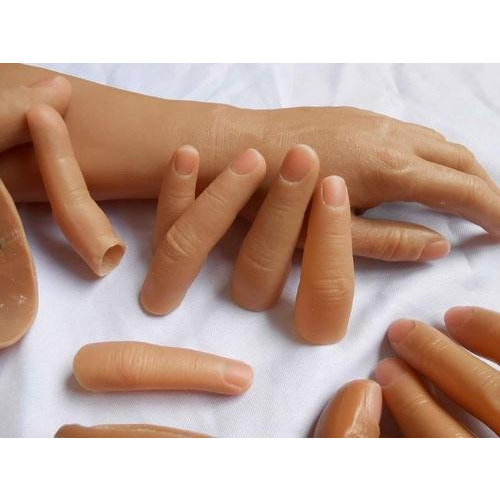
Finger Prosthetics, powered by Alatheia Prosthetics, makes custom medical-grade silicone prostheses for exactly these situations. Each one is hand-crafted and color-matched to the client’s skin tone, shape and nail detail. The team serves clients across the United States and says it can work in your home, your doctor’s office or its main office. Explore the options:
- Custom finger prosthetics for partial or full finger loss
- Thumb prosthetics, since the thumb plays a major role in grip
- Partial hand prosthetics for loss across several digits or the palm
- Prostheses for children with congenital differences or finger loss
You can see before-and-after examples in the gallery and read client testimonials. Finger Prosthetics offers a free consultation: request one online or call (800) 670-9550.
If your loss is above the wrist, a body-powered or myoelectric arm fitted by an upper-limb prosthetist is usually the right starting point. A good clinic will tell you honestly which route fits your goals.
Prosthetic Arm FAQs
How does a prosthetic arm work?
It depends on the type. A body-powered arm uses a cable and harness driven by your body movement. A myoelectric arm reads muscle signals through sensors in the socket and moves battery-powered motors. A passive arm does not move actively.
Is a myoelectric arm better than a body-powered arm?
Not automatically. Myoelectric arms offer more grip options and no harness, while body-powered arms are typically simpler, sturdier and less costly. The right choice depends on your limb, goals, work and budget.
How long does it take to learn to use a prosthetic arm?
It varies by person and device. Training is usually gradual and guided by a therapist or prosthetist, with wearing time and tasks added step by step.
Will insurance cover a prosthetic arm?
Coverage varies by plan; Medicare covers 80% of prosthetic limb costs, and private plans differ. Policies often require documented medical need, and myoelectric devices may require a functional evaluation showing that a simpler device is not enough. Ask your provider and insurer for requirements in writing.
Can children use a prosthetic arm?
Yes, though children outgrow sockets, so devices need regular adjustment or replacement. One study found better functional results in children who began using a prosthesis before age six. Families can discuss timing with a pediatric prosthetist.