
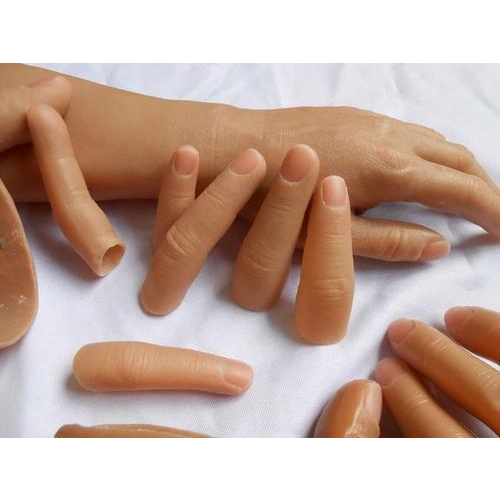
There is a question that almost every person living with finger loss eventually asks — quietly, privately, sometimes with a hesitation that speaks to how much is riding on the answer.
Will it actually look real?
Not almost real. Not close enough. Not real enough to fool people in low light or at a distance. Actually real. Real enough to wear to a job interview without your heart pounding. Real enough to be in a photograph with your family and not spend the rest of your life avoiding that photo. Real enough that when you reach across a table, your hand simply looks like your hand — not like someone else’s problem to politely ignore.
That question — will it look real? — is not vanity. It is not a superficial concern. It is one of the most fundamentally human desires that exists: the desire to feel whole. The desire to move through the world without the weight of constant self-consciousness. The desire to stop explaining, stop hiding, stop managing other people’s reactions to something that happened to you that you never chose.
At FingerProsthetics, powered by Alatheia Prosthetics, we have spent more than 25 years and more than 8,100 patients answering that question — not with promises, but with results. And the answer, done right, is this:
A truly custom silicone finger prosthetic does not just look realistic. In the hands of an experienced prosthetist, it looks like your finger.
This is how we do it — and why it matters more than anything else we could tell you.
The Fear Underneath the Question
Before explaining how silicone finger prosthetics achieve the level of realism they do today, it is worth acknowledging something that most medical websites never quite say directly.
The fear of a fake-looking prosthetic is real. It is legitimate. And it is one of the most common reasons people delay — sometimes for years — before reaching out for help.
Because a prosthetic that obviously looks artificial does not solve the problem. It replaces one kind of self-consciousness with another. Instead of hiding a missing finger, you are now managing the curiosity that a clearly mechanical or plastic-looking substitute attracts. That trade feels like no trade at all to most people — and it has kept an entire generation of amputees from discovering what modern custom silicone prosthetics can actually do.
The prosthetics that most people picture when they hear the word — rigid plastic shells, obviously mechanical joints, devices that clearly signal “prosthetic” to anyone who glances at your hand — are not what we make. They are not even in the same category as what we make.
What we make is something that requires a genuinely different word.
We make restorations.
What Makes a Custom Silicone Finger Prosthetic Look Real
The realism of a modern custom silicone finger prosthetic is not the result of any single technique or material. It is the product of multiple layers of precision craft working together — each one contributing something essential to a final result that the human eye reads as natural.
Medical-Grade Silicone — The Foundation of Everything
The material itself is where realism begins. Medical-grade silicone — the same class of material used in the most demanding medical applications — has properties that no other prosthetic material can replicate. It moves. It gives slightly under pressure. It catches light the way skin does, with the subtle translucency that makes real skin look alive rather than opaque.
When you look at a well-made silicone finger prosthetic in natural light, you do not see a surface that reflects light uniformly the way plastic does. You see something that absorbs and scatters light in layers — the way skin does. That quality alone is the difference between a prosthetic that looks like a prop and one that stops people in their tracks because they cannot tell the difference.
Skin-Tone Matching — The Art Nobody Talks About Enough
Every person’s skin is its own universe of color. It is not a single tone — it is dozens of tones layered over each other, shifting from the base of the finger to the tip, from the palm side to the back, across knuckles and nail beds and the subtle variations that accumulate from years of life in the sun, in the cold, in your particular body.
Matching that complexity is not a science project. It is an art form.
Our prosthetists work with each patient individually — studying the colors in their natural hand, understanding how those colors shift across different lighting conditions, and building a silicone prosthetic with layered pigmentation that replicates not just the dominant tone of your skin but the variations and depth that make it look alive.
The result is a finger that matches your natural hand so precisely that the prosthetic and the real hand become indistinguishable to the eye — not because the prosthetic has been disguised, but because it has been genuinely recreated.
Surface Texture — The Details That Fool the Eye
Skin is not smooth. It is a landscape of microdetail — the fine creases at every knuckle joint, the subtle pore pattern across the surface, the tiny lines that form from years of movement and use, the texture differences between the pad of a fingertip and the back of the finger.
Every one of these details is replicated in a custom silicone finger prosthetic from FingerProsthetics.
The creases at your knuckles — not generic knuckle creases, but yours, in the pattern specific to your hand. The surface texture that your skin has. The fingerprint detail at your tip. These are not decorative additions to an otherwise generic product. They are the difference between a prosthetic that looks like a finger and one that looks like your finger.
When a patient holds their hands out side by side — the prosthetic next to the natural fingers — this level of detail is what makes even careful observers look twice, lean in, and still not be certain which is which.
Nail Beds — The Detail That Completes Everything
Nothing reads as more unmistakably human than a well-formed fingernail. And nothing reveals a prosthetic more immediately than a nail that looks artificial — too uniform in color, too perfect in shape, lacking the subtle variations that make real nails look like they have been lived in.
Our prosthetics include custom nail beds that replicate the natural shape, color, and translucency of your own nails. The pink blush beneath the nail. The white of the free edge. The subtle curvature specific to your finger. Even the natural irregularities that make your nails look like yours rather than someone else’s.
This level of nail detail is often what patients find most striking when they see their prosthetic for the first time. It is the detail that signals completion — that transforms something that looked nearly right into something that looks exactly right.
What Our Patients Say About the Realism
These are not promotional composites. These are the words of real patients who lived with finger loss, worked with our team, and found something they did not entirely dare to hope for.
Bradley put it simply: “My family and friends are as impressed with how life-like it is.”
That sentence carries more weight than it might initially seem. His family knew him before. They knew his hand before. And they were still impressed by how closely the prosthetic matched what they remembered. That is not a mild compliment — that is the standard we set for every patient we work with.
Matt’s story is one we return to often. His hand surgeon prescribed a custom prosthesis, and when it was done — when the fitting was complete and Matt went home — his family did not notice. Not initially. Not at first glance. They saw his hand and it was his hand.
“So lifelike my family didn’t notice.”
Those six words represent everything we work toward. Every hour of craftsmanship, every iteration of skin-tone matching, every surface detail that most people would never consciously register but that the eye processes subconsciously and reads as real — all of it is in service of that moment. The moment when you stop being someone with a prosthetic and you are just yourself again.
Diana described it differently, focusing not on the appearance alone but on everything the appearance represented: “I want to thank you for all your hard and gorgeous work. This prosthesis resembles all the effort and love you placed into making it possible.”
And Claire, in perhaps the most direct statement of what realism actually delivers: “It’s truly boosted my confidence and changed my life for the better.”
The Different Prosthetics We Create — And What Each Looks Like
Custom Finger Prosthetics
A custom finger prosthetic from FingerProsthetics can replace a single finger, multiple fingers, a fingertip, or any partial finger segment. Each is designed individually — measuring not just the length and width of the prosthetic but every anatomical detail of the remaining finger and the natural hand, so the prosthetic integrates seamlessly.
From the outside, when done correctly, the prosthetic finger looks like the others. Not similar to the others. Like them.
Silicone Thumb Prosthetics
The thumb is architecturally different from the fingers — broader, shorter, set at a different angle, and carrying a disproportionate share of hand function. Replicating it convincingly requires a different approach.
Our thumb prosthetics are individually designed for each patient’s specific thumb anatomy — the shape, the angle, the specific way it relates to the rest of the hand when relaxed and when in use. The result is a thumb that not only looks natural in isolation but looks natural in the context of your complete hand, from every angle, in every position.
Partial Hand Prosthetics
When multiple fingers or a portion of the hand has been lost, the restoration challenge is greater — but so is the transformation. Our partial hand prosthetics restore the complete visual profile of a hand, with each replicated finger individually matched to the remaining natural fingers in tone, texture, proportion, and detail.
Patients who receive partial hand prosthetics often describe the experience of looking at their hands as something they had given up expecting to feel: normal.
The Process That Makes Realism Possible
The realism of a custom silicone finger prosthetic is not achieved overnight. It is the result of a careful, iterative process that begins with a free consultation and unfolds over several weeks of precise work.
The consultation is where we begin to understand your hand — your skin, your anatomy, your lifestyle, and what you need the prosthetic to do and look like in your daily life.
Measurements and molds capture the precise geometry of your residual limb and your natural hand — the dimensions, proportions, and anatomical details that will guide every subsequent stage of the fabrication process.
Skin-tone matching is a dedicated process in which we study your natural hand under different lighting conditions and develop the pigmentation formula that will be layered into the silicone to replicate your specific skin.
Handcrafting is where the prosthetic is built — layer by layer, detail by detail, with constant reference back to the measurements, photographs, and skin-tone samples from your consultation.
Fitting and adjustment ensures that the finished prosthetic fits your residual limb precisely, sits naturally alongside your other fingers, and looks correct from every angle and in every position your hand normally takes.
The process is thorough because the standard is high. And the standard is high because we understand what it means to you.
We Serve You Wherever You Are in the USA
One of the most important things to know about FingerProsthetics is that extraordinary prosthetic care is not limited to those who can travel to a specialist city or specialist clinic.
We serve patients across the entire United States. We come to your home, work with your doctor’s office, or welcome you to our main facility — whichever arrangement removes the most barriers for you and your family. Geography is not a reason to live with less than the best result available.
Wherever you are, the same level of personalized care, the same quality of craftsmanship, and the same standard of realism is available to you.
See for Yourself — Our Gallery Tells the Story That Words Cannot
Reading about realism is one thing. Seeing it is something else entirely.
We encourage you to visit our work gallery — a collection of before-and-after examples from real patients that shows exactly what custom silicone prosthetics look like in practice. Look at the hands. Look at where the prosthetic begins and where the natural finger ends. See if you can find the line.
In many cases, you will find it very difficult. In some, you will not find it at all.
That is not a trick of photography. It is the result of 25 years of specialized craft, 8,100 patients, and an unwavering commitment to a standard of realism that genuinely changes how people experience their own hands — and their own lives.
The First Step Is a Conversation — And It Costs You Nothing
If you have been living with finger loss and wondering whether a prosthetic could genuinely look real — the answer is yes. Not theoretically. Not with caveats. For the vast majority of patients, a custom silicone finger prosthetic from FingerProsthetics looks real in the way that matters: real enough to wear without thinking about it, real enough to stop hiding, real enough to start living again in the full, unhidden, comfortable way you deserve.
The first step is a free consultation. A conversation with our team where we look at your hand, understand your situation, explain exactly what is possible for you specifically, and show you examples of the work we have done for patients whose situations were similar to yours.
No cost. No commitment. No pressure.
Just honest information from a team that has spent a quarter century helping people find their way back to themselves.
📞 Call us at (800) 670-9550
📧 Email us at emil@alatheia.com
🌐 Contact us at fingerprosthetics.com/form/
We serve patients across the entire United States — at your home, at your doctor’s office, or at our main facility. Wherever you are, we are ready to help.
Because you have spent long enough wondering what is possible. It is time to find out.
Frequently Asked Questions — Silicone Finger Prosthetic Realism
Q1: How realistic do silicone finger prosthetics look today compared to older prosthetics?
The difference between modern custom silicone finger prosthetics and the prosthetics available even a decade ago is significant and, for most patients, genuinely surprising. Older prosthetics — often rigid plastic or basic silicone shells — could restore a general finger shape but struggled to replicate the subtle visual qualities that make real skin look real: the translucency, the texture variation, the color depth, the nail detail, and the way skin interacts with light. Modern medical-grade silicone combined with advanced pigmentation techniques and skilled handcraft has transformed what is achievable. Today’s custom prosthetics from specialists like FingerProsthetics are built with layered color pigmentation that replicates skin depth, surface textures that include knuckle creases and pore patterns, custom nail beds matched to the patient’s natural nails, and an overall level of anatomical accuracy that allows the prosthetic to pass visual inspection even at close range. Many of our patients report that family members, friends, and colleagues who see the prosthetic regularly — and know it is a prosthetic — still find themselves looking twice because the visual realism is so convincing.
Q2: Can a silicone finger prosthetic really match my exact skin tone?
Yes — and skin-tone matching is one of the most important and most skilled aspects of creating a truly realistic custom finger prosthetic. Every person’s skin is a unique combination of tones, undertones, and variations that shift across different parts of the hand, under different lighting conditions, and between different seasons. Generic or mass-produced prosthetics cannot replicate this complexity. A custom silicone prosthetic from FingerProsthetics is color-matched individually for each patient through a dedicated process in which our prosthetists study the patient’s natural hand directly and develop a layered pigmentation formula specific to their skin. This formula is built into the silicone in layers — not painted on the surface — which creates the depth and translucency that makes skin look real rather than opaque. The result is a prosthetic that blends with your natural hand across different lighting conditions, from different angles, and over time as your natural skin changes slightly with the seasons.
Q3: Will people at work or in social situations notice my finger prosthetic?
For most patients with a well-fitted, professionally crafted custom silicone finger prosthetic, the experience in social and professional settings is transformative. Many patients report that colleagues, clients, and new acquaintances who interact with them regularly have no idea they are wearing a prosthetic — not because those people are unobservant, but because the prosthetic genuinely does not draw attention. The goal of a custom prosthetic is not to fool people — it is to restore enough natural appearance that your hand simply does not become the focus of social interaction. For many of our patients, the most profound change after receiving their prosthetic is not that nobody notices — it is that they themselves stop noticing. The constant, exhausting awareness of how your hand looks in every interaction, the impulse to hide it under a table or behind your back or in your pocket — it fades. Because you know, when you hold your hand out, that it looks like your hand. And that knowledge changes everything about how you move through the world.
Q4: Does a silicone finger prosthetic look natural when the hand is in motion?
This is one of the most important questions about prosthetic realism — because a prosthetic that looks convincing in a still photograph but moves unnaturally in use is not truly realistic. Medical-grade silicone has a flexibility and give that allows it to move naturally with the hand, to flex slightly at the joints, to compress lightly under pressure the way skin does. A well-fitted custom prosthetic designed by an experienced prosthetist moves with your hand rather than against it. It does not hold rigidly in one position while your other fingers flex and move. It participates in the natural motion of your hand in a way that reads as organic to anyone watching. The fitting process at FingerProsthetics specifically evaluates the prosthetic in motion — in the natural positions and movements of the patient’s daily life — to ensure that the realism holds not just in a static position but through the full range of natural hand activity.
Q5: How do I find out what a realistic silicone finger prosthetic would look like on my hand specifically?
The only way to know with certainty what is achievable for your specific hand — your skin tone, your anatomy, your level of amputation, the relationship between the prosthetic and your remaining natural fingers — is to speak with someone who can actually assess your hand and show you examples of comparable cases. That is exactly what our free consultation is designed to do. During your consultation, our team looks at your hand directly, discusses your goals, shows you examples from our gallery of patients with similar situations, and explains specifically what is achievable for you. We do not offer generic promises or generic results — we offer personalized assessment and personalized results. The consultation costs nothing and commits you to nothing. It simply gives you the accurate, specific information that no website, no article, and no generic before-and-after photo can give you. Call us at (800) 670-9550, email us at emil@alatheia.com, or contact us at fingerprosthetics.com/form/ to schedule yours today.