
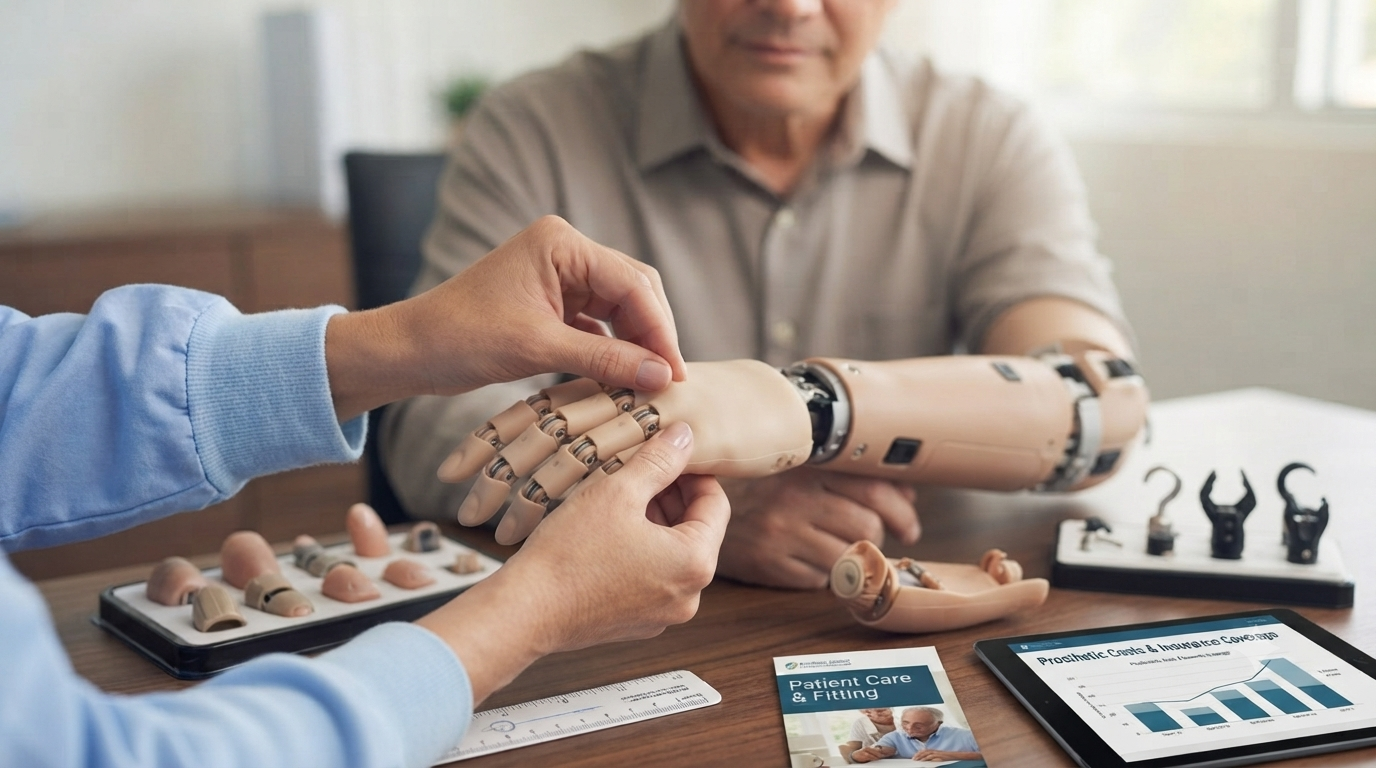
Losing a hand, a partial hand, or an arm changes more than your physical abilities. It affects how you work, how you connect with others, and how you see yourself. The good news is that prosthetic technology and craftsmanship have advanced enormously. Today, an artificial hand or artificial arm can be tailored to your anatomy, your lifestyle, and your goals.
This guide covers the main types of upper-limb prostheses, how to decide between them, and what to expect from the process.
What Is an Artificial Hand?
An artificial hand is a prosthetic device that replaces all or part of a missing hand. Some devices focus on function, such as gripping or holding objects. Others focus on restoring the natural look of the hand. Many combine both.
The right option depends largely on your level of limb loss:
- Finger or thumb loss: a custom finger or thumb prosthesis can restore both the look and some of the grip.
- Partial hand loss: a partial hand prosthesis replaces the missing sections while working with your remaining anatomy.
- Full hand loss: a complete artificial hand replaces the hand up to the wrist.
Many people assume a prosthetic hand has to be mechanical or robotic. In reality, a custom silicone artificial hand is a popular choice for people who want a realistic, comfortable, lightweight solution. These prostheses are handcrafted from medical-grade silicone and matched to your skin tone, including details like wrinkles, freckles, and fingernails.
What Is an Artificial Arm?
An artificial arm replaces a limb lost above the wrist, such as a transradial (below-elbow) or transhumeral (above-elbow) amputation. Because it has to replace more of the limb, it is usually more complex than a hand prosthesis. It may include a socket that fits over the residual limb, a joint at the elbow, and a terminal device such as a hand or hook.
There are three broad categories of artificial arm:
- Cosmetic (passive) arms. These restore the natural appearance of the limb. They are lightweight and lifelike, and they can help with stabilizing or carrying objects.
- Body-powered arms. These use cables and harnesses, operated by movements of your shoulder or upper body, to open and close the terminal device.
- Myoelectric arms. These use sensors that detect muscle signals in the residual limb and convert them into movement. They offer more natural control but are heavier and more expensive.
None of these is “best” for everyone. A carpenter, a pianist, an office worker, and a student will each prioritize different things.
Artificial Hand vs. Artificial Arm: Key Differences
| Factor | Artificial Hand | Artificial Arm |
|---|---|---|
| Level of loss | Finger, thumb, partial or full hand | Below-elbow or above-elbow |
| Typical complexity | Lower to moderate | Moderate to high |
| Weight | Often very lightweight | Varies by design |
| Fitting process | Molding, color matching, fit adjustments | Socket fitting, alignment, often training |
| Common focus | Natural appearance, comfort, partial function | Function, range of motion, independence |
If you have lost only part of your hand, you may not need a full arm system at all. A well-made partial hand or finger prosthesis can be a far more comfortable and natural-looking solution than people expect.
Why Realism Matters
For many people, appearance is not vanity. It is about being able to move through the world without feeling self-conscious. A realistic artificial hand lets you shake hands, attend meetings, or go to a family gathering without constantly thinking about your hand.
That is why custom silicone work has become so popular. A skilled prosthetist can recreate the shape of your knuckles, the creases in your skin, and even the look of your nails. At Finger Prosthetics, the focus is on prostheses that look like your own skin and restore confidence after loss. Their work, shown on the Our Work gallery, gives a good sense of what realistic results look like.
Types of Hand Prosthetic Solutions
Finger prostheses
If you have lost one or more fingers, a custom finger prosthesis can protect the sensitive area, improve grip support, and restore the appearance of your hand. Each one is made to match your finger shape and skin tone.
Thumb prostheses
The thumb is essential for gripping, writing, and holding objects, so thumb loss can be especially disruptive. A custom thumb prosthesis is built to match your anatomy and to support everyday tasks more naturally.
Partial and full hand prostheses
For more extensive loss, hand prosthetics can replace part or all of the hand. Lightweight silicone construction makes them comfortable enough to wear for long periods, while detailed finishing keeps them looking natural.
Prostheses for children
Children’s needs are different. They grow quickly, and prostheses may need to be adjusted or replaced over time. Specialized prostheses for children can support confidence and daily activities during important developmental years.
How to Choose the Right Artificial Hand or Arm
Choosing a prosthesis is a personal decision. These questions can help you narrow your options:
1. What is your level of limb loss?
Your anatomy determines which solutions are possible. A prosthetist can assess what will fit and work best.
2. What matters most: appearance, function, or both?
Some people want a prosthesis that looks completely natural. Others need strong gripping ability for work or hobbies. Be honest about your priorities, because they shape the design.
3. What does your daily life involve?
Think about your job, your hobbies, and the tasks you do most. Manual work, typing, driving, cooking, and sports all place different demands on a prosthesis.
4. What is your budget, and what does insurance cover?
Costs vary widely with complexity and customization. Insurance coverage depends on your provider and policy, so it helps to ask early.
5. How much maintenance are you comfortable with?
Simple silicone prostheses are generally easy to care for with mild soap and water. More complex systems may require more upkeep. You can find practical guidance on care of your prosthesis and use of your prosthesis.
What to Expect During the Process
While details differ between providers, the path to a custom artificial hand or arm usually looks like this:
- Consultation. You discuss your history, goals, and options. A good provider will listen first and recommend second.
- Measurements and molding. Your prosthetist takes measurements, photographs, or molds to capture your anatomy.
- Design and color matching. For silicone prostheses, skin tone, texture, and detailing are matched to your natural skin.
- Fitting and adjustments. The prosthesis is fitted, checked for comfort and security, and refined.
- Training and aftercare. You learn how to wear, use, and care for it so you get the most from it.
Because each prosthesis is handcrafted, the process typically takes several weeks. That time is worth it for a result that fits properly and looks natural.
Living Well With an Artificial Hand or Arm
Getting a prosthesis is the start of an adjustment period, not the end of one. A few habits help:
- Give yourself time. Learning to use a prosthesis, even a simple one, takes practice.
- Keep up with care. Gentle cleaning and avoiding harsh chemicals extend the life of silicone prostheses.
- Schedule check-ups. Fit can change over time, especially for children.
- Connect with others. Peer support from people with similar experiences can be encouraging and practical.
Many people find that the biggest change is emotional. When your prosthesis looks and feels like a natural part of you, it becomes easier to return to work, social life, and the activities you love. You can read real experiences on the client testimonials page.
Frequently Asked Questions
Is an artificial hand only cosmetic?
Not necessarily. Some are mainly cosmetic, while others support gripping, holding, and everyday tasks. Many combine both, depending on the design and level of limb loss.
How long does an artificial hand or arm last?
This depends on the type, materials, how often you use it, and how well you maintain it. With proper care, silicone prostheses can last several years.
Can children use an artificial hand or arm?
Yes. Children can benefit from custom prostheses, though they may need periodic adjustments or replacements as they grow.
How do I get started?
Begin with a consultation to review your situation and options. Providers such as Finger Prosthetics offer a free consultation and serve clients across the USA.
Final Thoughts
Whether you are exploring an artificial hand after a finger or partial hand amputation or researching an artificial arm after a larger limb loss, the best outcomes come from matching the prosthesis to your body, your goals, and your daily life. Take your time, ask questions, and look for a provider who treats each prosthesis as a personal, handcrafted piece.
If you are ready to explore your options, visit FingerProsthetics.com to learn more about custom silicone finger, thumb, and hand prostheses, or contact the team to book a free consultation.