
There is something that happens in the weeks after finger loss that nobody quite prepares you for.
It is not the big moments — the hospital, the surgery, the first look at your changed hand. Those are devastating in their own way, but they arrive with a kind of numbness that carries you through them.
What catches people off guard is the accumulation of small things.
The morning you reach for your phone and fumbling to unlock it takes three tries instead of one. The afternoon you try to button a shirt and give up, changing into something that pulls over your head. The evening you sit down to type an email and realize — really realize, for the first time — how much of what you do every day depended on a single finger you no longer have.
A door handle. A key. A zipper. A pen. A guitar string. A child’s hand reaching for yours.
Finger loss does not announce itself all at once. It reveals itself slowly, in the quiet moments of ordinary life, in the gap between what your hands used to do effortlessly and what requires effort now.
And somewhere in that accumulation of small losses, a question forms — one that is equal parts practical and deeply personal:
Can a finger prosthetic actually give that back?
At FingerProsthetics, powered by Alatheia Prosthetics, that question is one we have answered more than 8,100 times over more than 25 years. And the honest, careful, experience-based answer is this:
Yes. Not always completely. Not always identically. But more than most people dare to hope for before they begin.
This is everything you need to know.
Why Finger Function Matters More Than Most People Realize
Before getting into how prosthetics restore function, it is worth understanding just how significant finger function actually is — because most people only begin to appreciate it after they have lost it.
The human hand is one of the most mechanically sophisticated structures in the natural world. Each finger contributes to a specific set of functions — gripping, pinching, steadying, supporting, sensing — and the loss of even a single finger disrupts the entire system in ways that extend far beyond that finger’s direct contribution.
Consider the index finger. It is the primary contact point for pointing, triggering, and precision tasks. Lose it and you lose the intuitive precision grip that you have used without thinking since childhood.
Consider the middle finger. It provides the central pillar of grip strength and stabilizes objects held in the palm. Its absence shifts the distribution of force across the remaining fingers in ways that create fatigue, weakness, and a frustrating sense of the hand not working the way it should.
Consider the ring finger. Lose it and you begin to notice how much your grip depended on that finger to anchor objects against the palm during fine motor tasks.
And then consider the thumb — the single most functionally important digit in the human hand, responsible for approximately 40% of total hand function. The thumb makes opposition possible — the ability to bring a finger toward the palm in the pinching and gripping motions that human hands perform thousands of times every day. Lose a thumb and the functional impact on daily life is immediate, significant, and far-reaching.
Each of these losses is different. Each requires a different prosthetic approach. And each has a different functional restoration story — which is why the question “will a prosthetic restore function?” cannot be answered with a single yes or no. It has to be answered specifically, for your specific loss, your specific goals, and your specific daily life.
The Difference Between Cosmetic and Functional Prosthetics
This is one of the most important distinctions to understand as you explore your options — and one that is frequently misrepresented or oversimplified in online resources.
Cosmetic Prosthetics
A cosmetic prosthetic is designed primarily to restore the natural appearance of the hand. It looks like a finger. It matches your skin tone, your texture, your nail detail. It is worn to restore the visual completeness of the hand — to allow you to shake hands, appear in photographs, interact socially and professionally without self-consciousness, and simply look at your own hand without the constant reminder of what is missing.
A cosmetic prosthetic does not actively assist with grip in the mechanical sense — it does not flex or bend under motor power. But that does not mean it has no functional contribution. It does — and more significantly than many people initially expect.
Passive Functional Prosthetics
A passive functional prosthetic is a step beyond purely cosmetic. While it does not have active mechanical movement, it is designed with a shape, rigidity, and positioning that allows it to participate in grip and stabilization.
A passive functional prosthetic can act as a stabilizing surface — providing a contact point that allows objects to be held between it and the thumb or palm. It can support the barrel of a pen, hold the edge of a card, maintain contact with an object while other fingers perform a task. Many patients find that their grip strength and functional capability improves meaningfully with a passive functional prosthetic even without any active mechanical movement — simply because the prosthetic fills the gap in the hand’s architecture that was disrupting grip.
Active and Body-Powered Prosthetics
For some patients — particularly those with more extensive loss — active prosthetics that incorporate mechanical movement driven by body motion or external power sources are appropriate. These provide more direct functional restoration at the cost of greater complexity and different appearance characteristics.
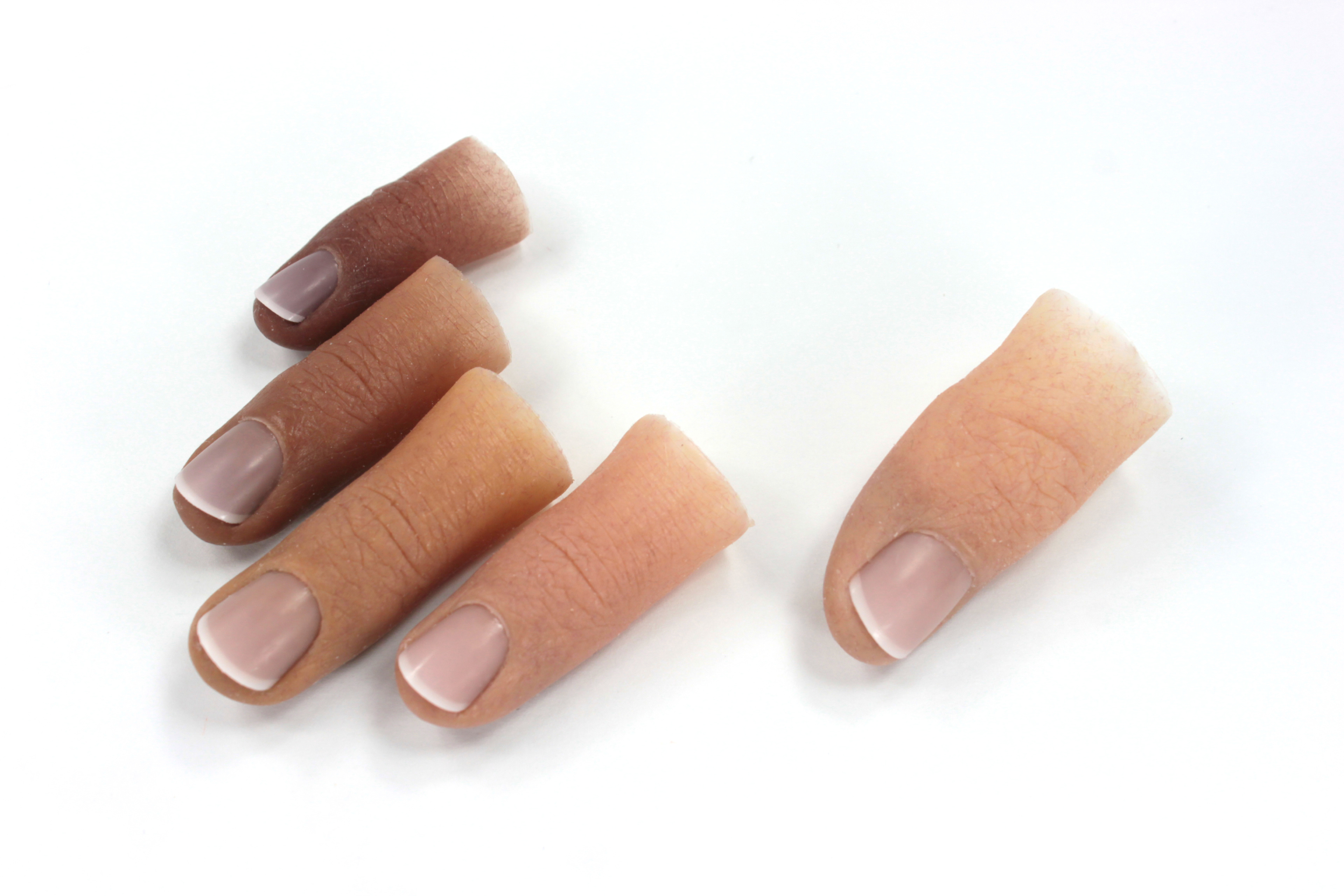
At FingerProsthetics, our specialty is custom medical-grade silicone finger prosthetics — passive and passive functional solutions that restore appearance and provide meaningful functional support. During your free consultation, we assess your specific situation honestly and, where a different approach might serve you better, we tell you that.
Real Daily Functions — What a Finger Prosthetic Helps With
This is the section most people read most carefully — because the question is ultimately not about prosthetics in the abstract. It is about your life, specifically. The things you do every day. The things you have been struggling with since the loss. The things you are afraid you will never do the same way again.
Here is an honest, specific account of the functional areas where a well-designed custom finger prosthetic makes a measurable difference.
Typing and Keyboard Use
This is one of the most immediately impactful functional benefits of a custom finger prosthetic — and one of the most commonly reported by patients across virtually every profession and lifestyle.
Typing is a bilateral, symmetrical activity. The two hands are expected to perform mirroring functions, with each finger occupying a specific key zone in the muscle memory developed over years of use. The loss of a finger disrupts that muscle memory entirely — the hand compensates, neighboring fingers stretch to cover keys they were not designed to reach, fatigue sets in faster, accuracy drops, speed drops, and what used to be effortless requires concentration.
A finger prosthetic restores the architectural presence of the missing finger — giving the hand its natural proportions and contact points at the keyboard. Many patients report that typing speed and accuracy improve significantly with a prosthetic, and that the fatigue associated with compensatory hand positioning reduces substantially. For anyone whose professional life involves significant typing — which in 2025 is most professionals — this functional restoration has direct and measurable impact on daily work quality and comfort.
Grip and Object Handling
Human grip is a system. The fingers work together, distributing force, sharing the load, creating the multiple contact points that allow objects of different shapes, sizes, and weights to be held securely. The loss of a finger creates a gap in that system — a contact point that is no longer there, a force distribution that no longer works as designed.
A custom finger prosthetic fills that gap. It restores a contact surface that the hand can use to distribute grip force more naturally, hold objects more securely, and approach tasks that require grip with more confidence and less compensatory strain.
Patients report improvements in their ability to hold cups and glasses, carry bags, handle tools, open jars, manage packages, and perform the hundreds of gripping tasks that daily life involves. The degree of improvement varies by the specific finger lost and the specific prosthetic design — which is exactly why the consultation matters so much.
Writing and Drawing
Fine motor tasks — the controlled, precise movements involved in handwriting, drawing, or any manual craft — are among the most sensitive to the disruption caused by finger loss. A missing finger changes the balance of the hand around a pen or pencil, alters the contact points that provide stability during precise movements, and forces compensatory adaptations that reduce control and increase fatigue.
A well-fitted prosthetic restores the hand’s natural geometry around a writing instrument. It provides a stabilizing surface and restores the natural weight distribution that makes precise movements possible. Many patients with creative or artistic professions — illustrators, architects, designers, calligraphers — have found that a custom prosthetic substantially restored their ability to work at the level they worked before their loss.
Holding and Caring for Others
This is the one that stays with people longest — the functional loss that cuts deepest and that no list of practical benefits fully captures.
The inability to hold a baby the way you want to hold them. The awkwardness of a child reaching for your hand and you being uncertain. The restraint in an embrace because your hand no longer feels like your hand.
A finger prosthetic does not restore sensation — it cannot give you back what you physically feel through a missing finger. But it restores presence. It restores the physical completeness of your hand in the moment of contact. And for many parents, grandparents, and partners, that restoration is more important than any mechanical function a prosthetic could provide.
Daily Self-Care and Independence
Buttons. Zippers. Shoelaces. Food preparation. Hair. Contact lenses. The countless small self-care tasks that hands perform automatically, without thought, until a finger is missing and each one becomes a reminder of the change.
A custom finger prosthetic supports these tasks by restoring a pinch and contact surface that allows fine motor activities to proceed more naturally. Patients consistently report improvements in self-care independence after receiving their prosthetics — and the emotional significance of regaining that independence is something that is genuinely difficult to put a value on.
The Thumb — Why Thumb Function Restoration Deserves Special Attention
If finger loss is significant, thumb loss is in a different category entirely.
The thumb is architecturally unique — positioned in opposition to the fingers, set at a different angle, and responsible for the pinch mechanics that underpin most of what human hands do. Grip, pinch, stabilize, oppose — the thumb participates in virtually every hand function, which is why its loss typically has a more dramatic functional impact than the loss of any individual finger.
Our thumb prosthetics are individually engineered for each patient — not just color-matched and texture-matched, but designed with attention to the specific angle, shape, and positioning that allows the prosthetic thumb to participate in the hand’s natural mechanics. Many patients with thumb prosthetics from FingerProsthetics report that key functional capabilities — the ability to hold a pen, grip a glass, button a shirt, use a phone — are substantially restored.
One patient described the experience of sensation traveling through the prosthetic: “I tap my fingers and I feel the sensation travel through them. I find that amazing.”
That sensation is not fabricated — it is the vibration traveling through the silicone into the residual tissue, a physical feedback that the prosthetic is doing what it was designed to do: participating in your hand’s life rather than sitting passively on it.
What a Finger Prosthetic Cannot Do — Honest Expectations
This section exists because we believe in honest information over comfortable promises.
A silicone finger prosthetic cannot restore sensation in a missing finger. The nerve endings that provided feeling in that finger are gone, and no prosthetic can replace what the nervous system has lost. Some patients experience indirect tactile feedback — vibration through the prosthetic’s silicone body, pressure transferred to adjacent tissue — but this is not the same as direct sensation, and it varies significantly between individuals.
A passive silicone prosthetic cannot perform mechanically powered grip on its own. It does not contain motors or actuators. Its functional contribution comes from its shape, its presence in the hand’s architecture, and its ability to act as a contact surface and stabilizing element — not from mechanical movement.
The degree of functional restoration varies by patient, by the specific finger or fingers lost, by the fit and design of the prosthetic, and by the patient’s willingness to work with the prosthetic through an adjustment period. Some patients experience dramatic functional improvement almost immediately. Others find the adjustment takes several weeks as the hand and brain adapt to the presence of the prosthetic.
We tell every patient these things during their free consultation — not to discourage, but because accurate expectations lead to better outcomes and deeper satisfaction than promises that are not fully realistic.
How We Serve You — Anywhere in the United States
FingerProsthetics serves patients across the entire United States, and we understand that the process of exploring prosthetic options is already demanding enough without adding the burden of long-distance travel to a specialist clinic.
We come to you. Whether that means visiting you at home, working alongside your treating physician or occupational therapist, or welcoming you to our main facility — the arrangement is built around what works for your life. The same standard of personalized care, the same quality of craftsmanship, and the same commitment to honest, thorough consultation is available to you wherever you are in the country.
The process begins with a single conversation — and that conversation costs you nothing.
Take the First Step — Your Free Functional Assessment Awaits
If you have been living with finger loss and wondering whether a prosthetic could genuinely help you function better — not just look better, but live better — the most useful thing you can do right now is speak with someone who can actually assess your specific situation.
During your free consultation with FingerProsthetics, we look at your hand, understand your daily life and the functional challenges you are experiencing, and give you an honest, specific assessment of what a custom prosthetic can and cannot do for you — based on your anatomy, your goals, and the way you actually live.
No generic promises. No one-size-fits-all answers. Just honest expertise applied to your specific situation, by a team that has spent 25 years and 8,100 patients learning exactly what finger prosthetics can give people back.
📞 Call us at (800) 670-9550
📧 Email us at emil@alatheia.com
🌐 Contact us online at fingerprosthetics.com/form/
We serve patients across the entire United States — at your home, at your doctor’s office, or at our main facility. Wherever you are, we are ready to help you find out what is possible.
You have been adapting long enough. Let us show you what it looks like when you stop adapting and start restoring.
Frequently Asked Questions — Finger Prosthetic Function
Q1: Can I type on a keyboard with a silicone finger prosthetic?
Yes — and typing is one of the functional areas where patients most consistently report meaningful improvement after receiving a custom finger prosthetic. Finger loss disrupts the natural geometry of the hand at the keyboard, forcing neighboring fingers to stretch and compensate in ways that reduce speed, accuracy, and comfort over extended typing sessions. A well-fitted custom prosthetic from FingerProsthetics restores the architectural presence of the missing finger, returning the hand closer to its natural keyboard geometry. Most patients find that their typing speed and accuracy improve noticeably after an initial adjustment period as the hand and brain adapt to the prosthetic’s presence. For professionals whose work involves significant keyboard use — which includes most modern working adults — this functional restoration has direct, measurable impact on daily productivity and comfort. During your free consultation, we assess your specific hand and the specific finger involved to give you an honest expectation of the typing improvement you are likely to experience.
Q2: Will a finger prosthetic help me grip things better?
For many patients, yes — a custom finger prosthetic meaningfully improves grip by restoring a contact surface and filling the architectural gap in the hand that finger loss creates. Human grip distributes force across multiple finger contact points simultaneously, and the loss of any single finger disrupts that distribution in ways that reduce strength, create compensatory strain, and make objects harder to hold securely. A prosthetic fills that gap — providing a surface against which objects can be steadied, pressure can be distributed, and the overall architecture of the grip can function more as designed. The degree of grip improvement varies based on which finger was lost, the fit of the prosthetic, and the individual patient’s residual anatomy. Thumb loss in particular has a dramatic impact on grip, and a well-designed thumb prosthetic can restore meaningful grip capability. Our free consultation assesses your specific situation and gives you an honest, personalized estimate of the functional grip improvement you can expect.
Q3: Can I hold and care for my baby or young child with a finger prosthetic?
This is one of the most personal and most important functional questions parents ask — and the answer is yes. A custom silicone finger prosthetic restores the physical presence and completeness of the hand in a way that makes holding, comforting, and caring for a child feel more natural and more confident. The prosthetic provides a contact surface and restores the natural proportions of the hand that make everyday physical caregiving — lifting, steadying, supporting, comforting — less effortful and more intuitive. Many of our patients who are parents describe the ability to hold their child’s hand naturally — with a hand that looks and functions like their hand — as one of the most emotionally significant benefits of their prosthetic. While sensation in the prosthetic itself is not restored, the presence of the prosthetic changes the physical and emotional experience of caregiving in ways that matter deeply to the parents who experience it. Contact us for a free consultation to discuss your specific situation and what a prosthetic can offer you as a parent.
Q4: Can a thumb prosthetic really restore hand function?
Yes — and thumb prosthetics typically produce the most dramatic functional improvements of any single-digit prosthetic. The thumb is responsible for approximately 40% of total hand function, making its loss proportionally more impactful than the loss of any individual finger. A well-designed custom thumb prosthetic from FingerProsthetics is engineered with attention to the specific angle, shape, and positioning of your natural thumb anatomy, allowing it to participate in the hand’s pinch and grip mechanics in a meaningful way. Patients with thumb prosthetics report improvements in their ability to hold pens and pencils, grip glasses and cups, button clothing, use smartphones and keyboards, and perform the hundreds of pinch-based tasks that daily life involves. One of our patients described tapping their fingers and feeling the sensation travel through them — an experience that captures how a well-fitted thumb prosthetic becomes a genuine participant in hand activity rather than simply a passive visual restoration. During your free consultation, we assess your specific thumb anatomy and discuss the realistic functional outcomes for your individual situation.
Q5: How long does it take to get used to using a finger prosthetic for daily tasks?
The adjustment period for a custom finger prosthetic varies between individuals but typically takes several weeks of regular use before daily tasks begin to feel natural with the prosthetic in place. The adjustment involves two parallel processes: the physical adaptation of the hand learning to use the prosthetic as part of its grip and movement system, and the neurological adaptation of the brain updating its body map to incorporate the prosthetic. Most patients notice meaningful improvement in comfort and functional confidence within the first two to four weeks of regular daily wear. Some patients adapt faster, particularly for specific tasks like typing where the benefit is immediate and clear. Others find that certain activities require more practice and patience. At FingerProsthetics, we provide detailed guidance on how to introduce the prosthetic into daily life progressively — starting with familiar, lower-demand tasks and building toward more complex activities as confidence grows. We also remain available to our patients through the adjustment period to address any fit concerns or questions that arise. Contact us for a free consultation to discuss the adjustment process and what to expect in your specific situation.